
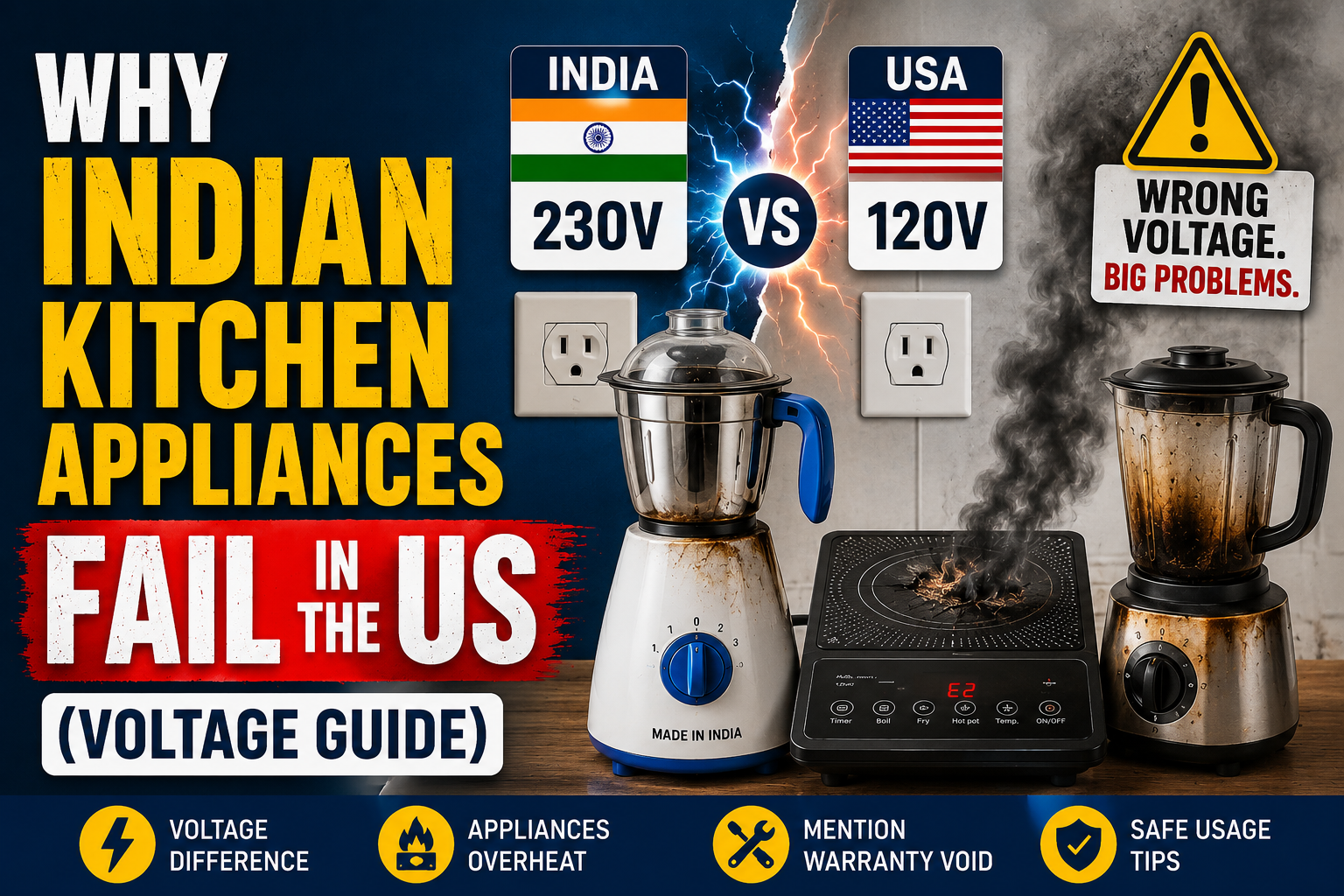
With this blog, we are trying to help immigrants of Indian origin who have settled in America and are keen lovers of Indian cuisine realize the reason behind their cherished kitchen gadgets breaking down when used in America.
Key Takeaways
- India operates at a voltage of 220-240V, while America operates at a voltage of 110-120V. A direct connection will definitely fry your appliance forever.
- You may use a voltage converter to solve this problem, but it may not be the right way to handle things in all cases.
- Voltage issues in kitchen equipment in the USA lead to more failure of Indian appliances than any other factor.
- Use of dual-voltage appliances or the American version of an Indian brand of electrical appliance is recommended in such situations.
- It is better to always remember to read the label that shows the voltage on the device itself.
The very moment you connect your Indian mixer grinder in the USA, you run into problems, and the motor produces a faint sound, starts overheating, or won’t even start at all. Does this scenario sound familiar? This is not a matter of bad luck but science and voltage discrepancies that affect millions of Indians residing outside India daily. Learn everything about 110v vs 220v appliances in the USA to prevent damage to your household appliances.
For high-quality household appliances made especially for US power supply that would not compromise Indian cooking quality, try DesiClik. This online shop specializes in providing Indian-American customers with a wide variety of kitchen appliances’ compatibility with Indian cooking in the USA.
What’s so Different About Indian and American Electricity?
The electrical current in the US operates at 110-120V and a frequency of 60Hz. The Indians use their appliances on 220-240V at a frequency of 50Hz. But this difference is more than significant. It means that the voltage is doubled.
As the Indian appliance is plugged into an American electric socket without any transformer, it only gets half the amount of voltage required. This problem leads to low performance and overheating, and these voltage issues in kitchen equipment in the USA lead to machine failure.
Why is it Important to Have a Voltage Difference for Kitchen Appliances?
The kitchen appliances, especially those that use a motor (mixer grinder, wet grinder, and food processor), have been known to be extremely delicate about the voltage differences. The motor built for 220v will simply not work efficiently at 110v, and after some time, it will generate too much heat and degrade the winding of the motor.
The issue gets even more complicated when it comes to the difference between 110v vs 220v appliances in the USA since the power outlets in America function at a 60Hz frequency, while in India, it’s 50Hz.
Which Indian Kitchen Appliances Are Most at Risk?
However, not all electrical devices react in the same manner when exposed to voltage disparity. Let’s take a look:
Most Vulnerable (Motorized Appliances):
- Indian mixer grinder in the USA – Most susceptible device
- Wet grinders
- Atta maker
- Juicers
Semi-vulnerable (Appliances using Heating Element):
Less Vulnerable (Appliance with Simple Resistive Elements):
- Electric kettle (with converter)
- Toaster
- Iron box (unless you have the right converter)
Identifying appliance compatibility in Indian cooking in the USA starts with knowledge of appliance categories.
Can Voltage Converter Help?
Sometimes, but not always. The role of a voltage converter is to either step up or step down the voltage according to the appliance’s requirements. This works fine when the use is moderate, but when the appliance is used continuously for several hours, like a mixer grinder and wet grinder, then voltage converters may pose difficulties:
- These devices produce heat while converting and, hence, add heat to the load of the appliance.
- These converters may be costly; for example, a quality 2000W converter is expensive.
- These cannot change the Hz; hence, the different Hz affects the motor speed.
- It adds another point for malfunctioning; if the device fails during operation, it will damage your appliance.
Therefore, it is advisable that you buy those kitchen gadgets that resolve the voltage issues in kitchen equipment in the USA.
What’s the Best Way to Cook Indian Food in the US?
Buy Appliances That Work With Both 220V & 110–120V or US Appliances
Several appliance makers have products that cater to the Indian-American demographic, designed to work perfectly on a 110V to 120V supply yet provide the high torque capacity required for tasks such as grinding wet rice batter and coconut chutney.
Things to consider while purchasing:
- An “110V / 120V” label or “Dual Voltage” rating
- Products certified by UL (US standards)
- Sufficient wattage for the job (750W–1000W for mixer grinders)
- US warranty available
Get Your Appliance Requirements From DesiClik: Verified Compatibility for US Kitchen Appliances
Here comes DesiClik to your rescue. This is a retailer that specializes in providing kitchen appliances suitable for Indian-American households; all products here have been certified for appliance compatibility with Indian cooking in the USA. If you need anything from an Indian appliance mixer grinder to a cooker or tawa, go for DesiClik.
What’s the Right Way to Confirm the Compatibility?
This is the most critical point, but it is one that is often ignored too. When inserting your Indian appliance into a US socket:
- Look for the label that is usually found at the bottom or back of the appliance.
- Locate the voltage rating; you should see something along the lines of “220–240V” or “100–240V.”
- Identify the frequency; you should get either “50Hz,” “60Hz,” or “50/60Hz.”
- In case the appliance has only the rating of 220-240V, don’t insert it without using the appropriate step-up transformer.
- In case it reads “100-240V,” it can be used directly.
Resolve the Voltage Issues
Indians are passionate about their cooking and deserve to enjoy it without worrying about the compatibility of kitchenware. From making fresh masala in the middle of the night to kneading dough for preparing weekend parathas, your gadgets should be equally productive as you are. It involves being aware of the problem and taking steps not to go for any shortcuts that might cause more harm than good.
For a smooth and hassle-free cooking experience in your Indian kitchen in the USA, check out DesiClik, your one-stop destination for everything Indian kitchen in the US, including the best Indian mixer grinder in the USA.
FAQs:
- Can I use my mixer grinder from India directly in the USA?
No, Indian machines are made for 220V, while America operates on 110V. Using the machine directly would break its motor.
- Will a voltage converter completely fix the problem?
Not really; it takes care of the voltage issue but not of Hz, causing heat issues.
- What is meant by ‘dual voltage’ on the appliance?
Dual voltage indicates that the appliance is suitable for use at both 110V and 220V.
- Do Indian brands make appliances that are compatible with 110V in the USA?
Yes, brands that sell their appliances through websites such as DesiClik do offer such machines.
- Is a plug adapter the same as a voltage converter?
No, a plug adapter converts only the type of plug into another, not the voltage.


